
The 4Cs of a Natural Diamond
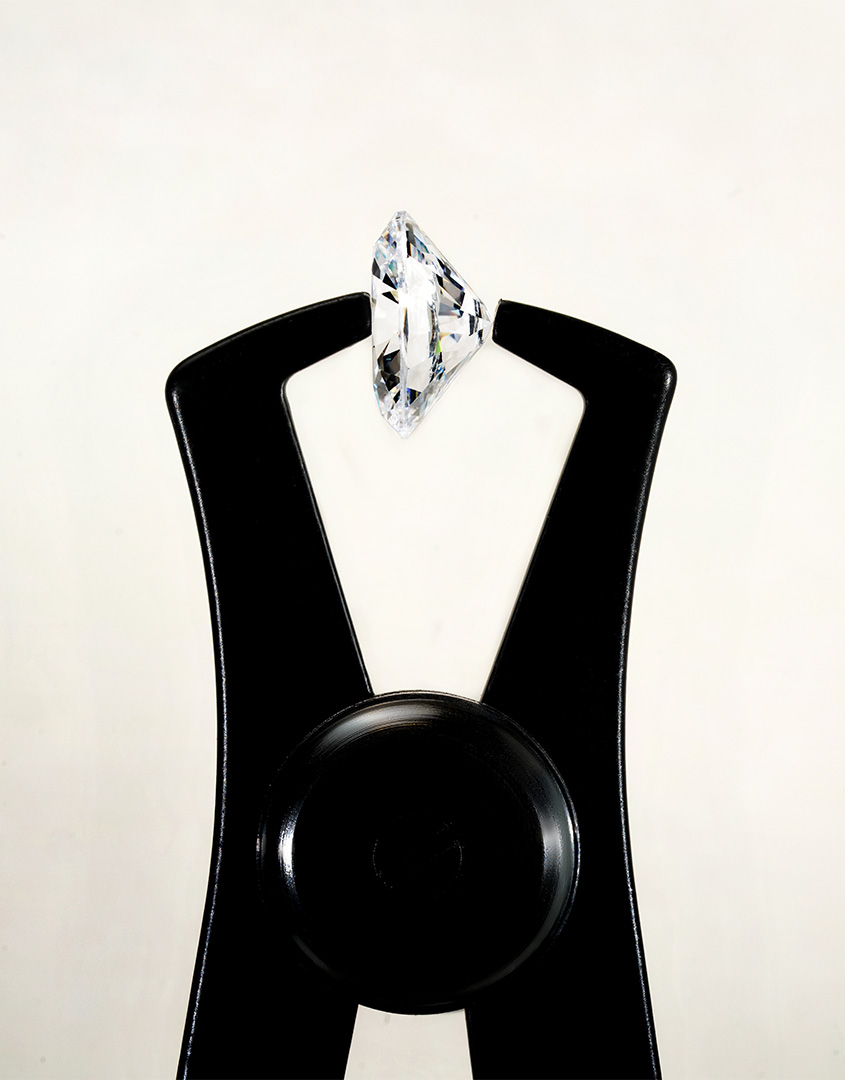
A Symbol of Eternity and Commitment, the Natural Diamond Captivates with Its Intrinsic BeautyUnderstanding the subtleties that define a diamond’s brilliance and value can be challenging. Fortunately, four essential characteristics, known as the 4Cs, allow us to evaluate the quality of a diamond: Carat, Clarity, Colour, and Cut.
In this detailed guide, we’ll explore each of these characteristics to help you better understand and appreciate the splendour of diamonds.
The Carat
Carat, the first and most impactful of the 4Cs
Among the 4Cs, carat is arguably the most crucial, as it accounts for up to 90% of a diamond’s price. Carat is the unit used to measure a diamond’s weight, not its size.
The word carat comes from the carob tree, whose seeds were historically used as a natural weight reference, each weighing approximately 0.20 grams. Thus, 1 carat equals 0.20 grams. Only around 5% of diamonds worldwide exceed 1.00 carat in weight.
The larger the carat weight, the more impressive and valuable the diamond. However, the relationship between carat and visual size is not linear: two diamonds with the same carat weight can appear different in size depending on their shape and proportions.
For example, an oval cut may look longer or shorter depending on how the weight is distributed between the pavilion (lower part) and table (upper part) of the stone.
While carat plays a major role in pricing, it should always be considered alongside the other 4Cs. The price per carat increases exponentially with weight.
Thanks to direct sourcing on the international diamond exchanges, Amantys adapts to each client’s preferences and budget, as defined during your initial consultation.


The Clarity
Clarity refers to the presence or absence of internal or external imperfections, known as inclusions and blemishes. These are natural features formed during the diamond’s crystallisation deep within the Earth.
Inclusions may appear as tiny fractures, black dots, clouds, or other marks only visible under magnification. The Gemological Institute of America (GIA), the most respected laboratory in the world and the one Amantys partners with, developed a standard clarity scale, ranging from: Flawless (FL). No inclusions or blemishes visible under 10x magnification to Included (I1, I2, I3). Obvious inclusions visible to the naked eye.
This scale includes six main clarity categories, broken into ten clarity grades:
- FL – Flawless
- IF – Internally Flawless
- VVS1 / VVS2 – Very, Very Slightly Included
- VS1 / VS2 – Very Slightly Included
- SI1 / SI2 – Slightly Included
- I1 / I2 / I3 – Included
It’s worth noting that the first six grades are invisible to the naked eye. The impact of inclusions depends on their size, location, and number, and how they affect the diamond’s overall appearance. For example, our Art Déco model, featuring an emerald cut, uses a shape known for its transparency rather than brilliance. As such, our gemmologists recommend a minimum clarity of SI1 for this cut to preserve visual purity.
Naturally, the purer the diamond, the rarer and more valuable it is.
The Color
Contrary to what one might assume, a diamond’s colour does not refer to vibrant tones, but rather to shades of white. Diamonds are graded on a colour scale from D to Z, where: D represents the purest, most colourless white, and Z indicates a noticeable yellow tint.
The most sought-after and valuable diamonds fall within the D to F range, where the difference in colour is virtually invisible to the naked eye. During our weekly gemmology sessions, professionals provide practical demonstrations under monochromatic lighting to help participants perceive the subtle variations in diamond colour. It’s important to note that colour is also a matter of personal taste, some connoisseurs actually prefer warmer tones with a faint hue, which can give the diamond a softer, vintage charm.
The Cut
The cut of a diamond refers not only to its shape, but also to the quality of its proportions, symmetry, and polish. It reflects how masterfully the diamond cutter has transformed a rough stone into a dazzling jewel.
The cut plays a critical role in the stone’s brilliance, as it directly affects how light enters and reflects within the diamond. An ideal cut maximises the stone’s brightness, fire, and scintillation, creating a truly sparkling effect. Diamonds are graded on a five-tier scale for cut quality: Excellent, Very Good, Good, Fair, and Poor.
The most well-known cut is the brilliant cut, a round shape with 57 or 58 facets, developed in 1919 by mathematician Marcel Tolkowsky, following precise proportions to optimise light return.
That said, other cuts, such as the princess cut, emerald cut, or marquise cut, each offer their own unique light reflection patterns and aesthetic character.
The term “Triple Excellent” (or “Triple X”) refers to diamonds that have achieved top grades for cut, polish, and symmetry. Among the 4Cs, cut is the only one entirely shaped by human craftsmanship, making it a true signature of the jeweller’s expertise.
The Fluorescence
Among the 4Cs of diamond grading, there is one quality that often sparks both curiosity and debate: fluorescence. Fluorescence is the ability of a diamond to emit a visible glow, usually blue, when exposed to short-wave ultraviolet (UV) light, such as sunlight or a specialised UV lamp. This property varies in intensity and is classified on a five-level scale, ranging from None to Very Strong. It is always indicated on GIA certificates provided by Amantys.
The visual impact of fluorescence can differ from stone to stone. In some cases, it may make the diamond appear brighter or more vibrant, especially in lower colour grades. In others, particularly at higher intensities, it may cause the diamond to appear slightly hazy or milky, particularly in colourless stones (D-F).
Traditionally, colourless diamonds without fluorescence are considered more desirable and command higher prices. However, some collectors and enthusiasts are drawn to the unique aura of fluorescent diamonds, appreciating the subtle, almost magical glow they can emit. Ultimately, fluorescence is not a flaw, but rather a subjective trait that should be considered according to personal preference. Whether you are drawn to its mysterious luminosity or prefer a more pristine appearance, it is best to view fluorescence as a matter of taste, not an absolute measure of quality.
The Introduction to Gemmology at Amantys
You now have a solid understanding of the fundamentals of gemmology, the science of natural diamonds. However, there are still many facets left to explore, and we are delighted to share them each week in our diamond laboratories, located at 5 rue de l’Échelle, Paris 1er, and 4–6 Cours de l’Intendance, Bordeaux 33000.
During an introduction to gemmology, you will learn how to assess a diamond’s quality and identify the characteristics that align with your expectations. The experts at Amantys will share their knowledge and answer all your questions. At Amantys, our commitment to our clients goes far beyond bespoke design, we aim to offer you a unique and educational experience that empowers you to make the right choice and find the diamond of a lifetime.
In conclusion
Whether you are seeking a large carat, impeccable clarity, exceptional whiteness, or a cut that maximises brilliance, the 4Cs are a valuable guide to selecting a diamond that reflects your preferences and aspirations. The right choice lies in a balanced approach, it’s simply a matter of adjusting the cursor to find the perfect compromise.
25 October, 2024


